
The range of developmental disorders that can result from FAS includes impairments to cognition and general intellectual functioning. In essence, children diagnosed with FAS can show delays in a wide variety of “thinking skills”; anything from verbal reasoning to an overall impaired IQ score. With an estimation of 2-5% of school-aged children being impacted to some degree by FAS, it has become a serious public health concern. Although the most severe deficits typically reside in children with the highest levels of prenatal alcohol exposure, the IQ deficits can be seen across the entirety of the FASD spectrum. FASD is the general, catch-all term for anyone impacted by prenatal alcohol exposure, regardless of the severity of their symptoms.
Although the presence of alcohol in a developing brain can impact any and all of those essential “thinking skills”, Doyle et al. focus their attention to adaptive functions. The authors define adaptive function as “… one’s ability to successfully function independently in everyday life and encompass tasks such as communication, socialization and daily living skills”. Children exposed to alcohol while in their mother’s womb can display deficits in all aspects of adaptive function, but particularly in areas of communication and socialization.

It has been supported that there is a relationship between one’s intellectual function, an ability to acquire and use knowledge, and adaptive functions. Based on the presence of this correlation, the authors believe that there will be a stronger relationship between IQ and adaptive function among lower functioning individuals. This study had two main goals: 1) to investigate the relationship between IQ and adaptive function in children with prenatal alcohol exposure (PAE) and 2) investigate if the relationship between adaptive functioning and intellectual function differs between high functioning and low functioning individuals. They hypothesized that “…youth with histories of heavy prenatal alcohol exposure would demonstrate impaired adaptive function…”.
For this study, the authors had 437 participants between 8 and 16, with an average age of 12.29 years. All subjects completed tests to determine impairments to particular skills, which was done using standardized neuropsychological assessments. They were also assessed for any head or face deformities, which is a common symptom associated with FAS. Of the 437 participants, 163 had prenatal alcohol exposure (PAE) and 274 were treated as nonexposed controls. PAE was defined as a pattern of heavy binge drinking during pregnancy, with consumption of more than 13 drinks per week or more than 4 drinks on one occasion.
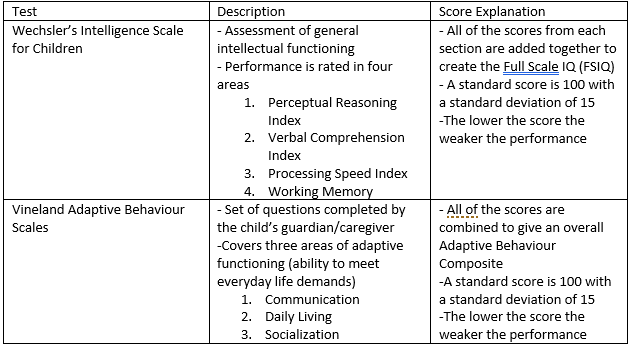
Based on the results of the tests, participants were then split into a high IQ or a low IQ group. High IQ was defined as a FSIQ at or above 85 points, while a low IQ was defined as a FSIQ below 85 points. Analyses were then performed to see if there was a connection between the FSIQ groups and adaptive functions. The authors noted that there were no outside factors, such as sex, presence/absence of ADHD or age, that would alter the results.
The results of the research show that there is a difference in FSIQ between the groups when comparing their communication scores. It was found that this correlation was stronger in the control group.

As shown by the graph, there is a significant difference in both the PAE and control groups with a low IQ. This means the statistical analyses done on the results showed they were not due to random chance, and actually due to a difference in the communication skills between the groups. For the high IQ group, there was only a significant difference in the control group. The data collected for the PAE children with a high intelligence range could not be shown to have communication scores outside of chance results.
The results from this study indicate that higher intellectual functioning is associated with higher adaptive functioning among non-exposed controls when compared to alcohol exposed youth. This relationship is primarily driven by a significant decrease in the communicative abilities of alcohol exposed youth. These results suggest that the data reported by caregivers may be impacted by a lack of communication among youth, as there was no significant difference between the socialization or Daily Living skills categories. The results of this study are consistent with other studies on developmental disorders, and it adds further support to the suggestion that with increasing IQ adaptive function does not correlate as strongly to IQ. In a nutshell, the lower the IQ, the more strongly it can be correlated to a child’s adaptive function, especially if the child has prenatal alcohol exposure.
This study is quite interesting because it links three common aspects of children with FAS; lowered IQ, issues with communication, and a decreased ability in their adaptive functioning. Furthering this, it appears that they are all interrelated, as the relationship between IQ and adaptive function seems to be driven by the lack of communication. This is interesting because one would think that a lowered IQ would be the driving force, not something that people think more of as a learnt behaviour.
Like many other developmental disorders, the symptoms that appear as a result of the deficits are multifactorial in nature. This means that the cause of the symptom can not be attributed to one thing and one thing only. This study really highlights how interconnected the brain is, especially in functions that don’t seem to be entirely correlated with one another, and how damage to one aspect of cognition can have widespread impacts.
Article Reference
Doyle, L.R., C.D. Coles, J.A. Kable, P.A. May, E.R. Sowell, K.L. Jones, E.P. Riley & S.N. Mattson. (2019). Relation between adaptive function and IQ among youth with histories of heavy prenatal alcohol exposure. Birth Defects Research. Doi: https://doi.org/10.1002/bdr2.1463
 FASt Facts