
Fetal alcohol syndrome (FAS) is a set of neurological and developmental disorders that occur due to prenatal exposure to alcohol. When a mother drinks alcohol during her pregnancy, she is directly exposing her developing child to that alcohol, or ethanol if you want to be truly scientific. This can cause severe developmental defects. Although there are many different factors that are thought to play a role in causing FAS, authors Granato and Dering take an incredibly focused look at how the presence of ethanol can impact a growing brain on a molecular level. They specifically look at how ethanol can induce the neurons to “self-destruct”, or apoptize. Although the authors focus is how ethanol can impact the neurons, they do acknowledge the fact that FAS is a multi-factorial syndrome, and that the neuronal death alone does not constitute the degree of symptoms that can occur.
Any type of change in the structure of a brain, typically on a molecular level, is referred to as neuroplasticity. According to the authors, and many other neuroscientists, most mental or neurological diseases can be interpreted as having some anomalies to the plastic changes of the brain. This is where the consumed alcohol comes in. The presence of ethanol in the developing brain can cause widespread damage, but not all brain cells are impacted to the same degree.

A lot of damage is isolated to the cerebral cortex, or grey matter, which is the outer surface of the brain. The cerebral cortex is made up of six different cell layers, each with a specific function. Compiling many different results from many animal experiments, the authors concluded that the cells in layer five, pyramidal cells, are the most prone to ethanol-induced damage. The loss of a large portion of pyramidal cells during development would be devastating, because pyramidal cells play a key role in cognitive abilities, which is your ability to acquire and learn new information.
So, apoptosis can occur in the presence of ethanol, and ethanol can also cause changes to the brain’s plasticity. But how are these two things related? A lot of the molecules that are responsible for controlling cell death are also involved in neuroplasticity. This means that the same molecules that are responsible for the ethanol-induced apoptosis, can also change the physical wiring of the brain. There have been many studies done on the different types of molecules that are involved in this pathway. One example is caspase-3, which is part of a family of proteins that plays a role in cell death and inflammation. When this protein is exposed to ethanol, it becomes upregulated, which means more of the protein is being produced. With more of the protein present, it increases the rate of apoptosis and leads to excessive neuron death. A secondary function of caspase-3, is in spine remodelling and other forms of plasticity. This correlates to the reduction in spine density that is commonly seen in patients with FAS.
One incredibly terrifying aspect of FAS is that alcohol consumption does not need to occur while in utero, it can also impact a child postnatal. This means that women not only have to be conscious of their alcohol consumption while they are pregnant, but also while they are breastfeeding. It takes only a small window of time during the developmental process for ethanol to cause damage to the child.
While a lot of the most severe and debilitating effects of ethanol can be seen in utero and as infants, the effects can propagate and continue to alter the brain structure long after infancy. One of the primary neurotransmitters, a messenger that transmits signals from the neuron to its target, is gamma-Aminobutyric acid (GABA).
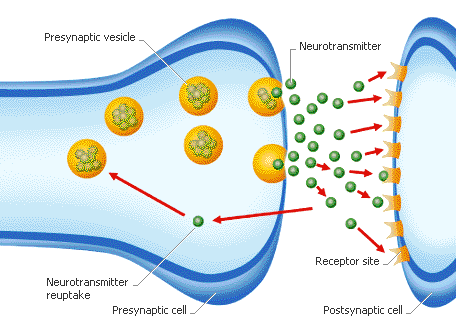
During development, typically in utero, the presence of GABA causes excitatory effects. This means that it will increase the probability of the signal continuing to another neuron. With the excitatory effect, and the presence of ethanol, the activity of immature neural networks can be increased. However, this is only an issue if alcohol is consumed during the first week of pregnancy. After the first week, GABA switches to have an inhibitory effect, it works to decrease the likelihood of a signal continuing to another neuron. The issue with inhibitory GABA comes later in maturity; when the FAS has already altered the connections made in the cerebral cortex (this is where those pyramidal cells come in!). The reduction in activity, caused in part by the damaged pyramidal cells, and the inhibitory effect of GABA, can depress the activity of the neuronal network and lead to apoptosis. This increased rate of apoptosis may lead to further depression of the neuronal activity, which creates a vicious cycle that can persist in the later stages of development. It is unknown if this cycle continues in a fully matured brain, or if it is the ability of a young brain to adapt that leads to such severe symptoms in some children.
Although a lot of the molecular effects of ethanol can be directly linked to apoptosis, there are other molecular mechanism that can cause the symptoms of FAS. One hypothesis is that movement of cortical neurons (the neurons that make up those six layers) can be induced by the presence of ethanol. This migration can cause damage because a neurons final location is essential in order for it to carry out its designated function. If the neuron ends up in the wrong place, it can lead to a loss of function which can be seen in the symptoms of FAS.
Within this article, the authors present some very compelling evidence for a molecular basis behind FAS. I find that when you are told why or how something is happening, in a way that physiologically makes sense, it can lead to a new understanding of the evolution of symptoms. It makes the disorder more real. Discovering causes behind why something occurs can also lead to more questions, which can lead to answers and eventually a way to help treat the symptoms based on the way they occurred in the first place.
Article Reference
Granato, A. & B. Dering. (2018). Alcohol and the Developing Brain: Why Neurons Die and How Survivors Change. International Journal of Molecular Sciences. 19(10) doi:10.3390/ijms19102992
 FASt Facts