This study by Pagnin et al. investigated if there was a relationship between alcohol consumption during pregnancy and mental disorders in children. The overall prevalence of women who consume alcohol has increased, and as a result, so has the number of women who consume alcohol while pregnant. One in ten pregnant women consume alcohol, and one in five that do, drink alcohol at a level that poses a serious risk to their unborn child. Although at the extreme end of the fetal alcohol syndrome spectrum are deformities of the face and head and dysfunction of the central nervous system, more subtle consequences can arise that fall under the category of alcohol-related neurodevelopmental disorders (ARND). Children with ARND are characterized as having behavioural or cognitive abnormalities. Cognitive abnormalities are mental disorders that typically impact learning, memory and problem solving.
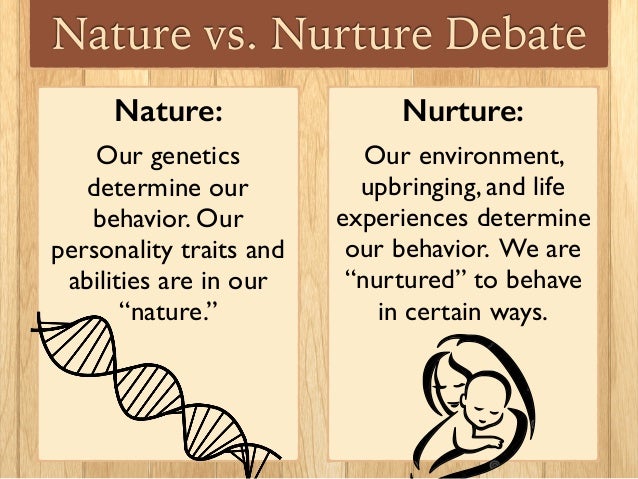
The link between low alcohol consumption and mental disorders is not as clear as with a high alcohol consumption. The interactions with their environment after a child has been born can be just as effective at causing a mental disorder as prenatal alcohol exposure (PAE). The link then between low to moderate alcohol consumption and mental disorders can be thought of as being part of a broad nature vs. nurture debate. Is it solely the alcohol that caused the disorder? Is it solely the postnatal environmental factors? Or is it a combination of both?
The purpose of this study was to investigate the patterns of alcohol consumption in twelve-year old children, specifically focusing on episodic and regular use of alcohol as risk factors for a child developing ADHD.
This study was longitudinal and prospective, which means it was conducted in a way that involved repeated observations of the study population over a period of time. The study started with 449 pregnant women attending a specific clinic and had no medical complications. After twelve years, only 81 mother-child pairs attended the scheduled psychiatric interview. The presence of mental disorders was assessed in the children by giving them the Kiddie Schedule for Affective Disorders and Schizophrenia for School-Aged Children. This is a large collection of symptom rating scales and diagnostic criteria for psychiatric conditions. It is presented as a set of screening questions and the given answers are used to determine if a mental disorder is present, and if it is, the severity of the present symptoms.
Mothers were also given tests; a Self-Reporting Questionnaire to identify any non-psychiatric disorder and the Alcohol Use Disorders Identification Test, which determines if there is any alcohol problem, both past and present. Other tests were also administered to determine if there was any risk drinking during pregnancy, if there is any dependence, and the number of trimesters alcohol was consumed.
Statistical analyses were done to determine the relationships between all the variables and to see if there was a connection between PAE and the presence of ADHD.
Of the children who were sampled with the questionnaire, 45.6% were identified as having some kind of mental disorder, with 22.8% of mental disorders being externalizing and 32.1% being internalizing. A child with an internalizing disorder will keep the problems to themselves, and a child with an externalizing disorder will have symptoms or behaviours that are visible to an observer. ADHD made up 25.9% of the mental disorders diagnosed in the all the children.

Out of 81 children, a total of 21 had ADHD. ADHD was present in 13 of the 35 males tested, and in 8 of the 46 females tested.
ADHD was considered an externalizing disorder, and of the 26 children with externalizing disorders, 81% had ADHD. Compared to children without ADHD, children with ADHD had a significantly greater proportion of mother’s who consumed alcohol in multiple trimesters, all trimesters or who consumed the alcohol in a binge manner.
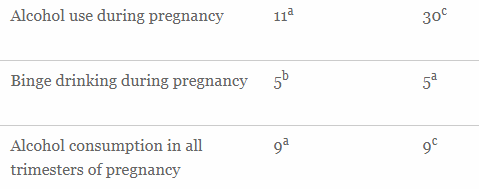
The maternal variables are presented on the left, children with ADHD compose the first column, and children without ADHD make up the second column. Of the 21 children with ADHD, 52.8% had mothers who used alcohol during pregnancy, 23.8% had mother’s who had alcohol in a binge manner and 42.8% had mothers who consumed alcohol throughout their entire pregnancy.
Any other risk factors or external variables were also analyzed, and none were found to have a significant impact on the results as shown.
Both the effects of regular use of alcohol and binge drinking were major factors associated with ADHD. When compared to children who’s mothers did not drink, consume alcohol in a binge manner at any time of their pregnancy or in all trimesters, children with mothers who did do one or all of the above were five times more likely to develop ADHD. A statistical analysis between males and females with ADHD showed that males were four times as likely to develop it.
The results of this study showed a correlation between PAE and the presence of mental disorders in children twelve years of age. Children with ADHD were linked to mothers who used alcohol during pregnancy, and more specifically mothers who consumed low-moderate doses of alcohol in all trimesters or in a binge manner during pregnancy. When looking at children in a general population, the occurrence of ADHD is 7.2%, while in children with FAS it occurs in approximately 51.2% of the population.
The results of this study are quite significant because they highlight the negative impacts of alcohol on an unborn child , even when consumed in low to moderate doses. It provides further information on how much alcohol is safe to drink during pregnancy, and the impacts that “Just a small glass” can have.
Although this study controlled for many other factors that could impact the results, overlapping interactions can not be controlled completely. When dealing with something that involves the development of a human, there are many other factors that could go into a child having ADHD. For example, ADHD is not always caused by alcohol, there has been a lot of evidence that supports specific genes passed down from parents can lead to ADHD. In this case, the child would have the gene for ADHD before the effects of the alcohol take place. There are also environmental factors that can come into play, such as diet, chemical exposure or a brain injury. Also, a lot of the time ADHD is simply over diagnosed in children, and doesn’t actually occur at the rates and with the prevalence that is being reported.

This study was overall very effective and provides ample evidence that prenatal alcohol exposure is associated with ADHD in childhood. The results of this study give rise to the belief that, if interventions were made with pregnant women to reduce the consumption of low to moderate amounts of alcohol and binge drinking, they could reduce the probability of ADHD occurring in their children .
Article Reference
Pagnin, D., M.L.Z. Grecco & E.F. Furtado (2018). Prenatal alcohol use as a risk for attention deficit/hyperactivity disorder. European Archives for Psychiatry and Clinical Neuroscience. Doi:
https://doi-org.cat1.lib.trentu.ca/10.1007/s00406-018-0946-7
 FASt Facts