
Fetal Alcohol Spectrum Disorders (FASD) can encompass a wide range of physical, cognitive and behavioural deficits due to the prenatal alcohol exposure (PAE). One area currently under heavy investigation is neurobehavioural function, specifically a patient’s communication abilities. Neurobehavioural function is how the nervous system (ie. the brain) relates to a person’s behaviour. Studies, for example the one done by Doyle et al., are looking at both functional and social communication, which is one’s ability to exchange information and interact with others. Young children with FASD experience communication impairment, which can drastically impact quality of life. Previous studies have found that communication skills in children and adolescents worsen with age, which suggest that communication skills are arrested in development, rather than just delayed.
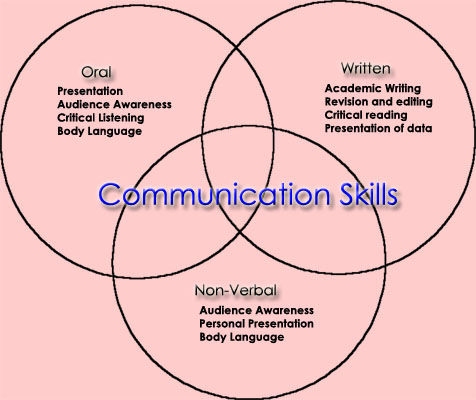
Individuals with FASD struggle to meet the communication demands required by society, which requires intact social cognition, executive functioning, and language skills. This study examines the relationship between cognitive variables and a patients communication abilities. By exploring the communication ability in patients with PAE, it will help determine the cognitive mechanisms that contribute to communication deficits, which could lead to improvements in therapies and preventative measures.
The authors explored whether or not cognitive variables could predict the communication ability among adolescents with heavy PAE. They hypothesized that:
- Cognitive variables (such as working memory and language) that are shown to be predictive in other neurodevelopmental disorders would significantly predict communication ability in alcohol exposed youth and;
- These cognitive variables would show differential relationships with communication ability between alcohol exposed youth and typically developing controls.
This study was done as part of the Collaborative Initiative on Fetal Alcohol Spectrum Disorders, Phase Three (CIFASD III), which is a comprehensive battery of studies on neuropsychological and behvaioural measures in adolescents with FASD. Adolescents in the study were between the ages of 10 and 16 years old, and were separated into a PAE group (n= 1420 and a control group (n= 160). Control subjects were recruited from the same communities as the PAE groups. Measures assessed the relation between communication and performance in three areas; working memory, executive function and language.
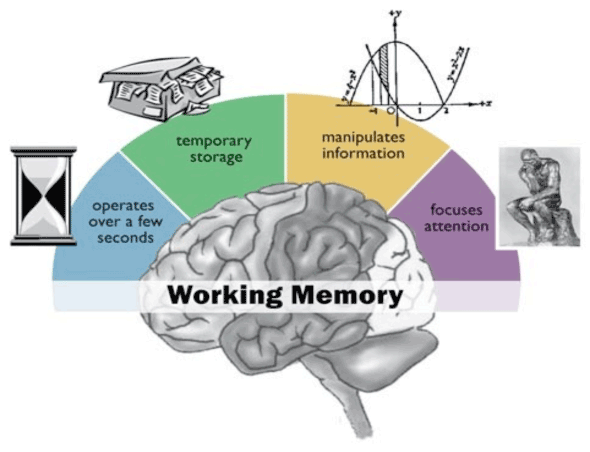
Multiple tests were administered that assessed socialization, daily living skills, spatial working memory and executive function. The tests were a mix of caregiver reports and neuropsychological assessments with the adolescent.
The results of the tests showed that the adolescents in the alcohol exposed group had a lower general cognitive ability, lower communication ability, and lower working memory compared to the control group. The alcohol exposed group showed a significantly lowered rate of cognitive and communication ability compared to the control group overall.
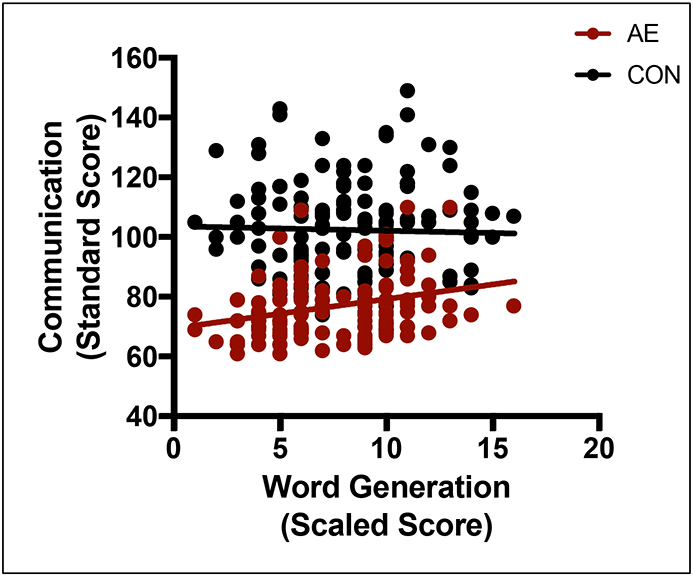
The area where there was the most significant difference was in the Word Generation score. Here, participants were required to “…name as many words that fall into a certain category… or start with a certain letter in 60 seconds” to assess how their behaviour controlled their language.

Overall, these results suggest that there is a difference in the communication abilities of adolescents exposed to alcohol in utero in comparison to a typically developing control group. The verbal reasoning aspect of the developmental delay is shown to impact the PAE group more strongly. Verbal reasoning is the ability to combine multiple pieces of information to produce one coherent piece of speech. Essentially, this means that patients with FAS have difficulty retrieving the words. They know what they want to say, but they can’t find the word in their mind in order to be able to produce a coherent thought or sentence.
The results of this study could be used to target speech and language therapies to have a greater impact on the aspects of language development most impacted by the alcohol exposure. Although the process of language comprehension and speech production is complex, any insight can help to improve the quality of life of someone experiencing the symptoms of Fetal Alcohol Syndrome.
Clinical interventions may also help to improve the communication deficits. Previous studies have shown that therapies directed at verbal reasoning have also shown improvements in self-regulation, attention and certain academic skills.
Article Reference
Doyle, L.R., E.M. Moore, C.D. Coles, J.A. Kable, E.R. Sowell, J.R. Wozniak, K.L. Jones, E. P. Riley & S.N. Mattson (2018). Executive Functioning Correlates with Communication Ability in Youth with Histories of Heavy Prenatal Alcohol Exposure. Journal of the International Neuropsychological Society. Doi: 10.1017/S1355617718000772
The answer to the verbal reasoning question: JR is to IP as NJ is to MH (a -1-2 rule)
 FASt Facts