
It is well known that there are certain psychological and social impacts as a result of in utero exposure to alcohol. Some of the symptoms include reduced cognitive functions, impaired verbal comprehension and certain behavioural issues, which may include rule breaking and aggressive behaviour. The results of these symptoms means that adolescents may have trouble in school or even issues with the law.
Despite all of the information present on the impacts of alcohol during childhood and throughout adolescence, there have been few studies done on how these symptoms impact someone with FAS during adulthood. A novel study done by Rangmar et al. predicted that the FAS study group would experience more problems in school, mental illness, and alcohol and illicit drug abuse.
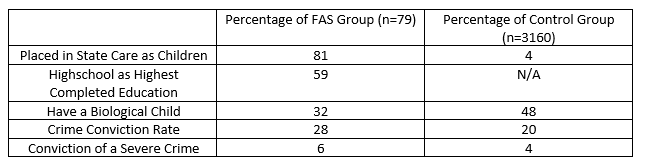
All the participants in this group were required to have all four of the common features of FAS; history of alcohol abuse while in utero, characteristic pattern of facial abnormalities, growth deficits and abnormalities of the central nervous system. The participants had a mean age of 32 years. The subject group was 37% female and 63% male. It is important to note that 81% of the adults in the FAS group had been placed in state care as children.
Overall, it was noted that participants in the FAS group had a lower level of education, they were less likely to have a biological child, had higher rates of crime, and were more likely to commit a severe crime.
The FAS group also had a higher rate of treatment for an alcohol-related disorder, drug abuse, treatment for a psychiatric disorder, self-inflicted injury and received at least one psychotropic drug.
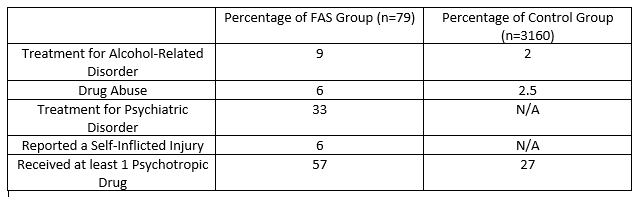
The results of this study show that adults with an FAS diagnosis have a higher level of secondary disabilities, which supports the authors overall hypothesis. The FAS adults experienced more trouble in school, limited career options, and had higher rates of drug and alcohol abuse.
This study was important in showing the results of FAS beyond adolescents. There are so many studies focusing on the impacts on children, and it is often forgotten that FAS is a lifelong disease. From the results of this study, one can infer that the symptoms of FAS do not disappear over the course of a lifetime, instead they actually seem to be exacerbated by the independence given in adulthood.
This study is limited in the fact that the subjects and controls are taken from a single country, so the data can not be extrapolated to a worldwide scale. A future study should try and take a broader perspective, to see if the data acquired from this study can be applied to patients with FAS worldwide.
Article Reference
Rangmar, J., A. Hjern, B. Vinnerjung, K. Stromland, M. Aronson & C. Fahlke (2015). Psychosocial Outcomes of Fetal Alcohol Syndrome in Adulthood. Pediatrics. Doi: 10.1542/peds.2014-1915
 FASt Facts